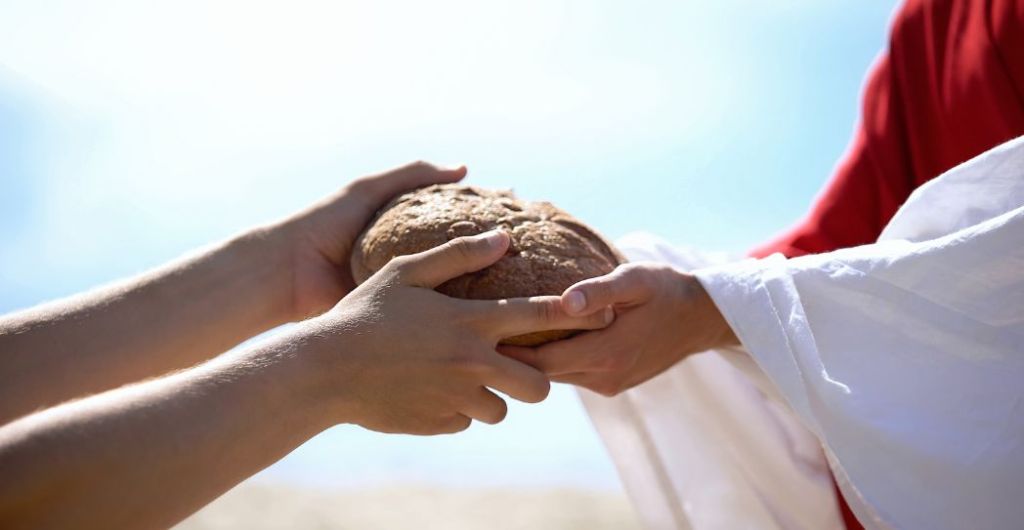
“I am the bread of life; whoever comes to me shall not hunger,
and whoever believes in me shall never thirst.” – John 6:35
Recently, Jessica H. posted her uplifting story of smelling freshly baked bread while crying out to the Lord in the middle of the night for much-needed rest after the birth of her third child. That story was familiar to me, as I remember her calling the morning after it happened and sharing in the awe of our God at this manifestation of His presence, basking with her in the delight of the scent of freshly baked bread which we both love. And hearing that story again brought up the same abundant joy that it did the first time…because it’s more than just a story. It’s a picture of one of the ways God chose to reveal Himself…and perfectly reflects the truth of one of His given names…The Bread of Life.
Ah…Jesus as the Bread of Life. Each time I hear Jessica recount this story, I’m reminded of its significance and how this title not only ties into fasting and sustaining, as Jessica so beautifully described, but also connects with His birth, His resurrection, and who He still is for us today. I find the connection between the three fascinating as it relates to Himself as this Bread.
HIS BIRTH. As prophesied in Micah 5:2, Jesus was born in Bethlehem, which you likely already knew. You might also know that Bethlehem was the City of David because it was also David’s birthplace. But did you know that Bethlehem literally means House of Bread? This showed even more significant symbolism for who He was and was to come: the Living Bread.
But this perfect symbolism didn’t originate there upon His birth. The significance of Jesus as Bread actually was foreshadowed 1400 years earlier when Moses was called to lead the Israelites out of Egypt. God had sent ten plagues upon Egypt. Yet, each time until the last, the Pharaoh’s heart was hardened against allowing the people to go worship God. It was the tenth and final plague that made the eternal difference: the death of every firstborn child. The Israelites were told to kill an unblemished paschal lamb in sacrifice and to place the lamb’s blood above their doors using hyssop to signify that they belonged to God and each life would be spared. This Passover alone is highly symbolic of the death of Christ as the unblemished Lamb whose blood was shed for us so that we may live. Hyssop, in case you didn’t know, was used for ceremonial cleansing in biblical times, which again was significant in the Passover story. It would also be significant at the time of Jesus’ crucifixion in that hyssop was used to offer Him a drink of wine vinegar just prior to His declaration that His work on earth was finished, which marked the cleansing of the sin of mankind by His blood that was shed. But there was much more symbolism than just the blood and the hyssop. There was also the bread.
Looking back again to the original Passover, we know from scripture that the Lord would bring the Israelites out of Egypt so quickly that they would not have time to add yeast to the bread. Instead, they would gather the unleavened bread and hurry to leave the country. On the third day, final freedom would come for them as they miraculously crossed the Red Sea and out of bondage forever. As directed by the Lord, the Israelites from that time forward would celebrate an annual feast of unleavened bread in remembrance of their salvation from slavery. All offerings were to be given to the Lord without yeast because yeast represented sin. As we have all experienced in our own lives, a little sin can quickly rise into something much bigger, and God was drawing them into that understanding.
HIS DEATH AND RESURRECTION. Fast forward about 1400 years from the Israelites’ freedom, past the birth of Christ in the City of the House of Bread, again to the time of His crucifixion. Not coincidentally, the day that Jesus was nailed to the cross was the first day of the Passover Celebration of Unleavened Bread. Stop and think about the significance of that. Since leaven or yeast referred to sin and Christ was sinless, He would then symbolically be the unleavened bread. But yet, He who knew no sin became sin and paid the price for that sin through His death on the cross. Stop to think about what happens when leaven is added to bread, and then read what the Bible says happened next in the Gospel story. On the third day the tomb was found empty with an angel beside it. What did the angel say about the missing Lord? “HE IS RISEN!” (Matthew 28:5). Christ, who took all of our sin (leaven/yeast)…ROSE from the dead. From that point forward, those who called upon His name and believed would experience complete salvation from the bondage of sin’s slavery just as the Israelites had.
BREAD OF LIFE TODAY. Jesus was not just the Bread of Life 2000 years ago. His declaration of Himself by this title is one of the great “I AM” statements which, as part of the unchanging nature of God, refers to the past, present, and future. In studying John 6:35 deeper, we find fascinating insights into Jesus as the Bread of Life that relate to His ability to raise us up in our current seasons. The word Jesus used in calling Himself the “Bread” is the Greek word (artos) which has a root word (airō) that literally means to raise up, elevate, and lift up, three primary ways Christ works in our lives. Strong’s concordance specifies the following three types of raising: 1.) to raise from the ground, take up: stones, 2.) to raise upwards, elevate, lift up: the hand, and 3.) to draw up: a fish. This brings to mind imagery of Jesus, as the Bread of Life, raising us up from death to life, removing our heart of stone, which causes us to lift up our hands in worship, then makes us fishers of men to be used as the Father draws people to Himself. But there is more to this root word as it also means to take upon oneself and carry what has been raised up, to bear and to carry it off. Yes, Jesus did exactly that. We have been raised up because He bore our sins and carried them away…permanently! And not only was the sin removed, but it was replaced. As Paul states, we should remove the old and put on the new. Newness in Christ. Oneness with Christ instead of with our sin.
This entire concept makes me stop and think about my own life. The more I take on assignments that are not from God, the more my stress level grows. The more I seek affirmation from others, the more my pride grows. The more I seek worldly pleasures, the more worldly pleasures I desire. Yet even when I am still, I’ve realized that the more I try to rise above stress, I am unable. The more I try to rise above selfish desires, I am unable. The more I try to rise above pride or false motives, I am unable.
What I have found, however, is that when I allow Jesus into my life and partner with the Holy Spirit to knead me together with Himself into complete oneness, that is when I rise above these things…not by anything I have done, but only by Jesus as the Bread of Life. By his power God raised the Lord from the dead, and he will raise us also (1 Corinthians 6:13). So that should change my posture and my focus. As Colossians 1:1-2 states, “since we have been raised with Christ, set your hearts on things above, where Christ is, seated at the right hand of God. Set your minds on things above, not on earthly things.”
When I turn from the sin of this world and instead seek the Kingdom of God, everything changes. Being part of the world continues to knead sin into my life, but Jesus explains there is a different type of yeast found only in the spiritual realm. In a parable documented in both Matthew 13:33 and Luke 13:21, Jesus explains, “The kingdom of heaven is like yeast that a woman took and mixed into about sixty pounds of flour until it worked all through the dough.”
As scripture tells us “…seek first the kingdom of God and His righteousness, and all these things will be added to you.” (Matthew 6:33). So, the more I seek His affirmations, the more my identity in Him increases in place of pride. The more I seek spiritual pleasures, the more I grow spiritually in place of desiring things of this world. The more I seek to abide in Him, the more I rise above my stressors to a place of abiding peace. The more I am in Him, or rather, the more He is in me, the more I bear His likeness and bear fruit. And the more I commune in remembrance and partake of Him as the Bread of Life, the more my soul is nourished.
So, where are you at today? Have you been feeding on what the world has to offer and now feel spiritually malnourished? Could you use some of His soul-nourishment just like me, so that the things from above rise up in your life rather than earthly things? Do you feel a weariness and depletion where there seems to be a great lack within your soul? Then remember how He provided manna for the Israelites and ask Him today to be your Daily Bread. Do you feel alone and isolated in this season? Remember, too, that He is the Bread of Presence as symbolically represented in the tabernacle (Exodus 25:30), which means you are never truly alone. He is ever before you to be all the nourishment you’ll ever need. And most of all, always remember that His statement of being the Bread of Life is a promise to which you can cling. Now and forevermore.
Ardently His,
Leah
To download the Ardently His app, click here.




 Ardently HIS
Leave a comment